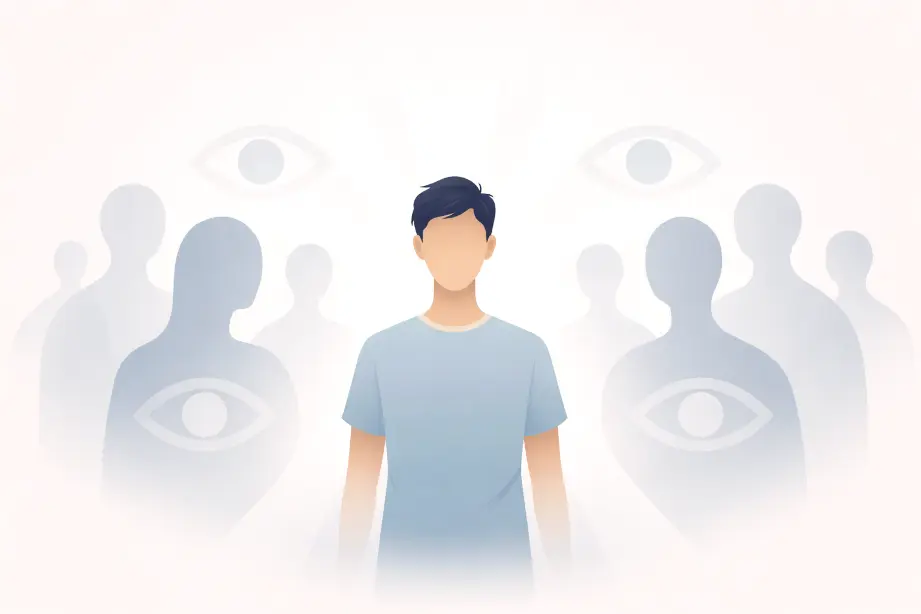
Have you ever noticed yourself acting differently when someone is watching? Maybe you become more careful with your words, more polite, more productive—or strangely more anxious. This shift can happen even when the observer isn’t judging you or hasn’t said a single word.
This isn’t a personal flaw or a sign of insecurity. It’s a deeply human response shaped by psychology, social learning, and the brain’s sensitivity to social context. Feeling observed activates internal systems designed to protect reputation, belonging, and safety.
This article explores why people change their behavior when they feel observed, how this response developed, and how it influences everyday decisions—often without conscious awareness.
The Brain Is Wired for Social Awareness
Humans evolved in groups where survival depended on cooperation. Being accepted by others meant access to resources, protection, and shared knowledge. Being excluded could be dangerous.
Because of this, the human brain developed a strong sensitivity to social cues. Even today, long after survival no longer depends on small groups, the brain still monitors how it might be perceived by others.
Observation Signals Potential Evaluation
When you feel observed, the brain often interprets it as potential evaluation. Someone might form an opinion, make a judgment, or decide how to treat you in the future.
This possibility—real or imagined—activates attention and self-monitoring. You become more aware of your actions, posture, tone, and choices.
Self-Monitoring Increases Under Observation
Self-monitoring is the process of observing your own behavior in real time. When you’re alone, self-monitoring is usually low. Your actions flow naturally.
When you feel watched, self-monitoring increases. You begin checking yourself internally:
- “How do I look right now?”
- “Does this make sense?”
- “What will they think if I do this?”
This shift can improve performance in some situations, but it can also disrupt natural behavior.
Why Self-Monitoring Can Feel Uncomfortable
High self-monitoring divides attention. Instead of focusing fully on the task or interaction, part of your mind is focused on managing impressions. This can create tension, hesitation, or stiffness.
The Fear of Social Consequences
Even subtle observation can trigger concern about social consequences. These concerns are often quiet and automatic, not dramatic or conscious.
The brain asks questions like:
- Will I seem competent?
- Will I seem rude?
- Will this change how they see me?
Behavior changes are often attempts to reduce the risk of negative outcomes.
Why This Happens Even Without Judgment
You don’t need actual criticism to feel evaluated. The possibility alone is enough. The brain prefers prevention over repair, so it adjusts behavior in advance.
Social Norms Become More Salient
When you’re alone, personal preferences guide behavior. When you feel observed, social norms become more prominent.
You’re more likely to:
- Follow rules closely
- Avoid unusual actions
- Choose safer or more conventional responses
- Suppress impulses that might seem inappropriate
This doesn’t mean people become dishonest. It means behavior becomes more aligned with what is socially acceptable.
Why Observation Can Improve Performance
In some cases, being observed increases focus and effort. This is often referred to as social facilitation.
When tasks are familiar or well-practiced, observation can:
- Increase alertness
- Boost motivation
- Encourage attention to detail
This is why people may work harder in public spaces or perform better when accountability is visible.
When Observation Backfires
If a task is complex, new, or emotionally sensitive, observation can increase pressure instead. Self-monitoring becomes excessive, and performance may decline.
The Role of Identity and Reputation
Behavior changes are often tied to identity management. People care not just about what they do, but about what their actions signal.
Feeling observed brings identity into focus:
- “What kind of person am I being right now?”
- “Does this match how I want to be seen?”
This internal alignment process influences choices, sometimes more strongly than practical concerns.
Why Even Imagined Observation Matters
Interestingly, people can change behavior even when no one is physically present. Cameras, mirrors, online profiles, or even imagined audiences can trigger the same effect.
The brain responds to the idea of being seen, not just actual observation.
The Internal Observer
Over time, social feedback becomes internalized. You learn how others might react, and that learned perspective becomes an internal observer guiding behavior.
What Most People Get Wrong About This Response
Many people assume that changing behavior under observation means being fake or inauthentic. In reality, it reflects adaptability.
Humans adjust behavior based on context. This flexibility allows cooperation, coordination, and mutual understanding.
Adaptation Is Not Deception
Acting differently in different settings doesn’t mean losing authenticity. It means responding to social information.
When Observation Becomes Limiting
Problems arise when concern about being observed becomes constant. Chronic self-monitoring can lead to:
- Anxiety
- Reduced creativity
- Emotional exhaustion
- Difficulty expressing genuine thoughts
In these cases, the brain treats everyday situations as evaluative, even when they aren’t.
How to Respond More Freely When You Feel Observed
1) Shift Focus From Impression to Intention
Instead of asking how you are being seen, focus on what you are trying to do or communicate.
2) Normalize Imperfection
Most people are more focused on themselves than on judging others. Remembering this reduces pressure.
3) Practice in Low-Stakes Settings
Repeated exposure to observation in safe environments teaches the brain that being seen is not dangerous.
4) Recognize When Observation Is Imagined
Not every situation involves evaluation. Noticing when the sense of being watched is internal can reduce unnecessary tension.
Final Thoughts: Being Seen Is a Human Experience
Changing behavior when you feel observed is not a weakness. It’s a reflection of social intelligence. The challenge is not eliminating this response, but understanding it.
When awareness replaces fear, observation can become a source of focus rather than pressure.
The goal is not to stop caring how you’re seen.
It’s to care without losing yourself.