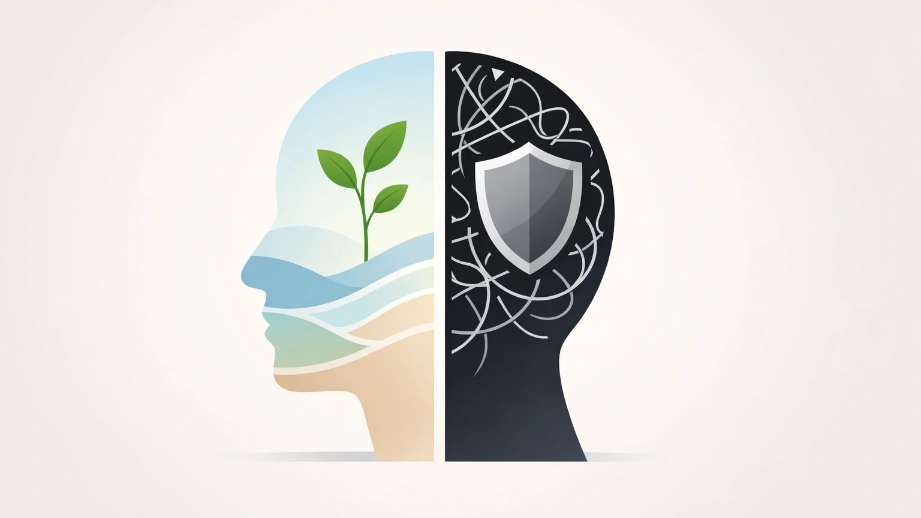
Why Your Brain Resists Change Even When You Want It
Have you ever been genuinely motivated to improve your life—only to find yourself slipping back into old habits a few days later? It can feel confusing, even frustrating, because the desire is real. But the resistance is real too. The truth is, your brain isn’t “broken” or “lazy.” It’s doing what it was built to do: protect you, conserve energy, and reduce uncertainty.This article explains the hidden psychology and neuroscience behind why change feels hard even when you want it, and how to work with your brain instead of fighting it.
Change Triggers Your Brain’s “Safety System”
Your brain constantly asks one question in the background: “Am I safe?” Not just physically safe, but socially safe, emotionally safe, and mentally stable. When you try to change something—your routine, identity, relationships, career path—your brain often interprets it as a threat, even if the change is positive.
Why? Because change increases uncertainty, and uncertainty is expensive for the brain. You may consciously believe, “This is good for me,” but deeper systems may read it as: “This is new. New is unpredictable. Unpredictable is risky.”
Why “Good Change” Still Feels Stressful
Even positive changes can bring pressure:
- New expectations (What if I can’t keep it up?)
- New identity (If I change, who am I now?)
- Social exposure (Will people judge me or stop supporting me?)
- Loss of comfort (Old habits may be unhealthy, but they’re familiar)
This is why you can be excited and anxious at the same time. Your intention wants the upgrade. Your nervous system wants stability.
Your Brain Prefers Predictable Pain Over Uncertain Progress
One of the most surprising truths about human behavior is this: people often choose familiar discomfort over unfamiliar improvement. Not because they love suffering, but because the brain can “map” familiar pain. It knows how to survive it.
For example, you might dislike your current routine, but your brain understands it: when to wake up, what to avoid, what makes you feel temporarily better, and how to get through the day. Change breaks that map.
The Comfort of the Known
Familiar patterns reduce cognitive load. When you repeat the same behaviors, the brain spends less energy planning and evaluating. That energy-saving feature is useful—but it also makes habits sticky.
So when you try to change, your brain may push back with thoughts like:
- “Let’s start tomorrow.”
- “This isn’t the right time.”
- “What’s the point?”
- “I’m too tired today.”
These thoughts often feel logical in the moment, but they can be protective reflexes—your brain’s way of steering you back to the known.
Habits Live in the Energy-Saving Part of the Brain
Habits aren’t just repeated actions—they’re energy-saving programs. When a behavior becomes a habit, it moves into systems that require less conscious effort. That’s why you can drive a familiar route and barely remember it, or open your phone without realizing you picked it up.
This automation is helpful, but it creates a big challenge: most people try to change habits using willpower alone. Willpower is limited because it requires conscious control, and conscious control is tiring.
Why Willpower Fails (Even for Smart, Motivated People)
Willpower drops when:
- You’re stressed or emotionally overloaded
- You didn’t sleep well
- You’re hungry or mentally fatigued
- Your day is full of decisions
- You’re socially drained
When willpower is low, the brain falls back to automation. That’s why you can be “serious” about change in the morning and still drift back by evening. It’s not a moral failure. It’s a brain-energy reality.
Identity Is the Hidden Gatekeeper of Change
Many people try to change behavior without realizing they’re also challenging identity. But your brain protects identity strongly because identity provides a stable sense of self. If a change threatens how you see yourself, resistance increases.
For example:
- If you identify as “not disciplined,” disciplined behavior can feel fake.
- If you identify as “the helpful one,” setting boundaries can feel selfish.
- If you identify as “the relaxed one,” ambition can feel like betrayal.
The Subtle Inner Conflict
You might consciously want to change, but unconsciously fear what that change implies: “If I succeed, will people expect more from me?” or “If I grow, will I lose who I used to be?”
This inner tension can show up as procrastination, avoidance, or constant “researching” instead of acting. It’s not because you don’t care. It’s because part of you is trying to keep the self-image stable.
Social Belonging Can Quietly Block Your Progress
Humans are wired for belonging. Your brain treats social rejection like danger. So if a change might alter how others see you, your brain may resist—even if nobody explicitly says anything.
This can happen in small, subtle ways:
- You avoid improving because it might make friends feel uncomfortable.
- You downplay goals to avoid judgment.
- You keep old habits because they keep you connected to certain people.
Sometimes resistance isn’t about the change itself. It’s about what the change might cost socially.
What Most People Get Wrong About Change
Most people assume change requires more motivation. But motivation is unreliable. It spikes and dips. If your system depends on “feeling ready,” you’ll stall whenever life gets heavy.
Another common mistake is aiming for big change too quickly. Large changes create large uncertainty, which triggers stronger resistance. The brain responds better to small, repeatable signals of safety.
Change Isn’t a Battle—It’s a Negotiation
If your brain is resisting, it’s usually trying to protect something:
- energy
- identity
- predictability
- social belonging
- emotional safety
Instead of forcing change through pressure, you’ll get better results by reducing the brain’s perceived risk.
How to Work With Your Brain (Practical, Realistic Methods)
1) Make Change Smaller Than Your Brain Can Argue With
If the step feels too big, your brain will generate reasons to avoid it. Start with a version so small it feels almost silly.
- Instead of “exercise every day,” start with “put on workout clothes.”
- Instead of “write a chapter,” start with “write 100 words.”
- Instead of “eat perfectly,” start with “add one healthy item.”
Small actions reduce uncertainty and build evidence: “I can do this.”
2) Reduce Friction in the Environment
Your brain follows the path of least resistance. If your environment supports old habits, your brain will default to them.
- Make the good habit easier: prepare tools, simplify steps, remove setup time.
- Make the old habit harder: add obstacles, delay access, remove triggers.
This is not “cheating.” It’s behavioral design.
3) Use a “Next Action” Plan, Not a “Perfect Plan”
Big plans often fail because they require constant decision-making. Instead, identify the next clear action you can do even when tired.
Ask: “What is the smallest next action that moves me forward?”
4) Expect Resistance, Then Pre-Decide Your Response
Resistance isn’t a sign you’re doing it wrong. It’s a predictable phase. Plan for it.
- When I feel like quitting, I will do 5 minutes instead of stopping.
- When I miss a day, I will restart the next day without punishment.
- When I feel overwhelmed, I will simplify the goal, not abandon it.
5) Build Identity Evidence Through Repetition
Identity changes when you repeatedly act in a new way. You don’t become disciplined by thinking about discipline—you become disciplined by collecting small proof points.
Each small action is a vote for a new identity. Over time, the brain accepts the new pattern as “who you are,” and resistance decreases.
When Change Feels Impossible, It Might Be Emotional, Not Logical
Sometimes resistance isn’t about planning or effort. It’s about emotional protection. If a habit helps you regulate stress, loneliness, or fear, your brain will cling to it even if it causes problems.
In that case, trying to remove the habit without replacing its emotional function creates a gap. Your brain doesn’t like gaps. It will refill them with the old behavior.
Ask This Quiet Question
“What feeling does this habit help me avoid or manage?”
If you can name the feeling, you can design a healthier replacement: a short walk, a message to a friend, a calmer evening routine, a non-digital break, or a structured wind-down ritual.
Final Thoughts: Your Brain Isn’t Your Enemy
Your brain resists change because it prioritizes safety, predictability, and energy efficiency. That’s not weakness—it’s survival design. When you understand this, you stop blaming yourself and start building change the way the brain learns best: small, consistent signals that the new path is safe.
Change becomes easier when you stop demanding instant transformation and start creating conditions where progress can repeat. And once repetition becomes routine, the brain stops resisting—because the new behavior becomes familiar.
If you’re stuck, don’t ask, “What’s wrong with me?”
Ask, “What is my brain trying to protect?”