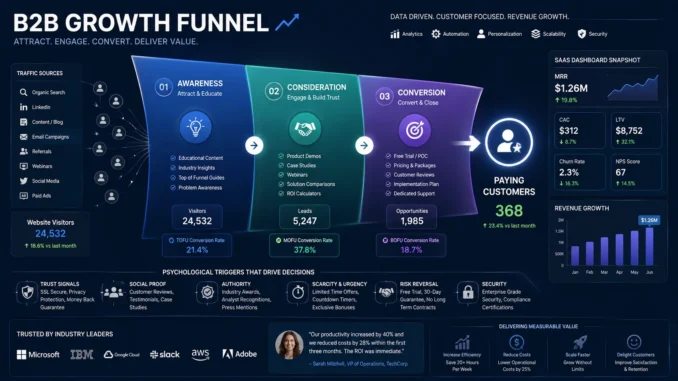
Why Some Businesses Convert Visitors Automatically While Others Leak Revenue
Let’s start with a hard truth:
Most businesses do not have a traffic problem.
They have a funnel psychology problem.
The Illusion of “More Traffic”
Here’s what struggling businesses believe:
“If we get more visitors… sales will grow.”
Sounds logical.
But reality says otherwise.
Because traffic alone does not create revenue.
Buyer movement does.
The Revenue Leak Most Businesses Ignore
Now consider this:
Visitors land on your website.
They browse.
They click.
And then?
They leave.
No inquiry.
No purchase.
No conversion.
That is revenue leakage.
Why Visitors Don’t Convert
Here’s the deal:
People rarely buy instantly.
Not because your product is bad.
But because your funnel creates uncertainty.
Buyers ask themselves:
- “Can I trust this?”
- “Is this worth it?”
- “Why should I act now?”
- “What happens next?”
If your funnel fails to answer these…
They leave.
Traffic Without Funnel Psychology Is Expensive
This is critical:
Every visitor costs money.
Paid ads.
SEO investment.
Content creation.
Sales effort.
And when visitors leave without converting?
Your acquisition costs explode.
The Hidden Buyer Decision Process
Now here’s what most businesses miss:
Buying is psychological.
Not technical.
Visitors move through emotional checkpoints:
- Attention
- Interest
- Trust
- Confidence
- Action
If one stage fails…
The funnel breaks.
Sales Funnels Are Behavioral Systems
This is the breakthrough:
A sales funnel is not just pages.
Not forms.
Not buttons.
It is a buyer behavior system.
Designed to guide decisions.
Why Some Funnels Feel Effortless
Ever notice this?
Some funnels feel natural.
Easy.
Logical.
Almost automatic.
That’s not luck.
That’s psychology design.
Those funnels reduce uncertainty.
And certainty creates action.
The Cost of Friction
Here’s another hidden killer:
Friction.
Too many steps.
Confusing messaging.
Long forms.
Poor offer clarity.
Each friction point creates hesitation.
And hesitation destroys conversions.
The Shift That Changes Everything
Stop asking:
“How do we get more visitors?”
Start asking:
“How do we move buyers through decisions?”
Because conversion is guided behavior.
Not random luck.
Automatic Conversion = Controlled Psychology
This is the key idea:
The best businesses do not force sales.
They engineer buyer momentum.
By controlling:
- Trust
- Perception
- Urgency
- Decision ease
That’s why their funnels convert automatically.
What’s Next?
Now the real question is:
What funnel strategies actually increase conversions predictably?
Because not all funnels work.
Some leak money.
Others become revenue machines.
High-Converting Funnel Strategies That Drive Revenue Predictably
Let’s get practical:
You now understand that funnels are psychological systems.
So how do you make them convert?
By designing for buyer behavior.
Quick Funnel Strategy Breakdown
| Strategy | Psychological Trigger | Revenue Impact |
|---|---|---|
| Authority Landing Pages | Trust bias | Higher conversions |
| Social Proof Stacking | Validation psychology | Reduced hesitation |
| Friction Reduction | Cognitive ease | More completions |
| Offer Sequencing | Commitment psychology | Better buyer progression |
| Urgency & Scarcity | Loss aversion | Faster action |
| Multi-Step Funnels | Micro-commitments | Higher lead quality |
| Behavioral Retargeting | Familiarity effect | Recovered conversions |
1. Authority Landing Pages – Build Instant Trust
Here’s the deal:
Visitors judge your business in seconds.
If the page feels weak…
They leave.
So establish authority fast:
- Clear positioning
- Strong headlines
- Results-driven messaging
- Credibility markers
Authority lowers perceived risk.
And trust increases conversions.
2. Social Proof Stacking – Reduce Decision Anxiety
Now consider this:
Buyers look for reassurance.
They ask:
“Has this worked for others?”
Answer that with proof:
- Testimonials
- Case studies
- Review counts
- Client logos
- Performance metrics
Because validation reduces hesitation.
3. Friction Reduction – Make Action Feel Easy
This is critical:
Complex funnels kill conversions.
Too many steps = decision fatigue.
So simplify:
- Short forms
- Clear CTAs
- Simple navigation
- Minimal distractions
Because easy decisions convert better.
4. Offer Sequencing – Don’t Ask for Too Much Too Soon
Here’s what many businesses get wrong:
They ask for commitment immediately.
Big mistake.
Instead, sequence trust:
- Value first
- Small commitment next
- Larger conversion later
This mirrors natural buyer behavior.
5. Urgency & Scarcity – Trigger Faster Decisions
Now here’s powerful psychology:
People fear losing opportunities.
More than they value gaining them.
This is loss aversion.
Use urgency carefully:
- Limited-time offers
- Enrollment deadlines
- Capacity limits
This creates momentum.
6. Multi-Step Funnels – Build Commitment Gradually
Here’s something smart:
Small commitments increase bigger commitments.
Examples:
- Step 1: Choose business size
- Step 2: Select goals
- Step 3: Enter contact details
Why does this work?
Because commitment builds psychologically.
7. Behavioral Retargeting – Recover Lost Buyers
This is essential:
Most visitors won’t convert immediately.
That does not mean they’re lost.
Retarget based on behavior:
- Viewed pricing?
- Visited product page?
- Started form?
Tailored follow-up improves recovery rates.
The High-Value Funnel Tech Stack
Now let’s connect strategy with monetization infrastructure:
1. Funnel Builders – Conversion Architecture
Design optimized buyer journeys.
- Best For: Funnel creation
- Impact: Higher conversion efficiency
2. CRM Platforms – Sales Pipeline Visibility
Track leads through every funnel stage.
- Best For: Pipeline management
- Impact: Better sales control
3. Heatmap & Session Tools – Behavior Visibility
See exactly where users hesitate.
- Best For: Funnel optimization
- Impact: Reduced leakage
4. Marketing Automation Platforms – Follow-Up at Scale
Nurture leads automatically.
- Best For: Conversion timing
- Impact: Better close rates
5. AI Personalization Engines – Smart Buyer Experiences
Adapt offers dynamically.
- Best For: Conversion optimization
- Impact: Higher relevance
The Key Insight
Funnels do not convert because they exist.
They convert because psychology is engineered correctly.
So Why Do Buyers Actually Move Through Funnels?
This is where it gets deeper.
Because tactics alone do not explain conversions.
Buyer psychology does.
The Psychology Behind Funnel Conversions (Why Buyers Actually Move Forward)
Here’s the truth:
People do not move through funnels because your pages exist.
They move because the funnel reduces uncertainty.
Buyer Psychology Is the Real Funnel Engine
Let’s start here:
Buying decisions are rarely logical.
Even in business.
Because people buy emotionally first.
Then justify logically later.
That means your funnel must influence psychology.
Not just deliver information.
Decision Fatigue Kills Conversions
Now consider this:
Every decision costs mental energy.
Too many choices?
Too much text?
Too many buttons?
The buyer gets tired.
This is decision fatigue.
And tired buyers do nothing.
So simple funnels convert better.
Cognitive Ease Creates Momentum
This is critical:
The easier something feels…
The safer it appears.
Buyers prefer clarity:
- Simple offers
- Clear messaging
- Obvious next steps
Because easy decisions feel low risk.
Loss Aversion Drives Action
Now here’s powerful psychology:
People fear losing opportunities.
More than they value gaining benefits.
This is loss aversion.
Examples:
- “Limited availability”
- “Enrollment closes Friday”
- “Pricing increases soon”
When buyers fear missing out…
Momentum increases.
Social Validation Reduces Risk
Here’s what every buyer thinks:
“Did this work for others like me?”
That question determines trust.
Social proof answers it:
- Testimonials
- Client stories
- Review metrics
- Business case studies
Validation lowers hesitation.
Commitment Psychology Builds Buyer Momentum
This is where funnels get smart:
Small commitments lead to larger commitments.
If a buyer clicks…
Answers a question…
Downloads a guide…
They become psychologically invested.
This increases future conversion probability.
Trust Progression Matters
Now here’s what most businesses ignore:
Trust is not instant.
It grows step by step.
Buyers need:
- Credibility first
- Proof second
- Confidence third
- Action last
Skip the progression?
Conversions collapse.
The Psychology of Funnel Drop-Offs
Let’s be honest:
When buyers leave…
It’s usually psychological.
Common causes:
- Confusion
- Low trust
- High friction
- Weak relevance
- Poor urgency
Drop-offs are behavior signals.
Not random traffic loss.
The Momentum Effect
Here’s the breakthrough:
Good funnels create momentum.
Momentum reduces hesitation.
Because once buyers move forward…
Continuing feels natural.
This is why structured funnels outperform generic websites.
The Core Insight
Funnels convert by controlling buyer psychology at every stage.
Attention.
Trust.
Confidence.
Commitment.
Action.
The Shift That Changes Everything
Stop asking:
“Why are visitors leaving?”
Start asking:
“Which psychological barrier stopped them?”
Because every leak has a behavioral reason.
So How Do You Build a Funnel That Converts Predictably?
This is where everything becomes actionable.
Because psychology without systems doesn’t scale.
Now let’s build the full conversion machine next.
How to Build a Sales Funnel That Predictably Converts Visitors Into Buyers
Now let’s turn buyer psychology into predictable revenue:
You understand why funnels work.
You see what drives conversions.
But here’s what matters most:
Building a repeatable funnel system.
The Biggest Funnel Mistake
Let’s be honest:
Most businesses send traffic directly to weak offers.
No trust.
No buyer warming.
No psychological progression.
Just:
“Buy now.”
That rarely works.
Because cold buyers resist pressure.
The Predictable Funnel Framework
Here’s the system:
Attract → Build Trust → Reduce Friction → Convert → Optimize
This is how scalable businesses grow.
Step 1: Attract (Bring in Relevant Buyers)
Start here:
Wrong traffic destroys funnel performance.
You need intent-matched visitors.
Target pain-driven messaging:
- Revenue growth
- Lead generation
- Automation
- Operational efficiency
Because relevant visitors convert better.
Step 2: Build Trust (Lower Buyer Resistance)
This is critical:
Trust must come before conversion.
Add trust accelerators:
- Client logos
- Testimonials
- Case studies
- Media mentions
- Guarantees
Because uncertain buyers do not act.
Step 3: Reduce Friction (Make Decisions Easy)
Now simplify everything.
Remove conversion blockers:
- Long forms
- Confusing offers
- Too many choices
- Unclear CTAs
Because complexity creates abandonment.
Step 4: Convert (Create Controlled Momentum)
This is where action happens.
Guide buyers with:
- Strong offers
- Urgency triggers
- Simple commitment steps
- Clear next actions
Because momentum increases completion rates.
Step 5: Optimize (Scale What Works)
Now build efficiency:
Track funnel performance carefully.
Measure:
- Landing page conversion rate
- Click-through behavior
- Form abandonment
- Sales close rates
- Revenue per visitor
Small changes create huge ROI improvements.
The Funnel Revenue Flywheel
Here’s how growth compounds:
- Better traffic → stronger buyer fit
- Stronger fit → higher trust
- Higher trust → better conversions
- Better conversions → lower acquisition costs
- Lower costs → more scaling capacity
And the cycle keeps growing.
The 80/20 Rule of Funnel Optimization
You do not need endless hacks.
You need core behavioral fundamentals:
- Clear trust signals
- Low friction
- Strong relevance
- Smart sequencing
These drive most funnel performance.
The Identity Shift That Changes Everything
Let’s reframe your thinking:
You’re not building landing pages.
You’re engineering buyer decisions.
And engineered decisions create scalable revenue.
From Random Traffic to Predictable Buyers
This is the final insight:
Traffic alone does not grow businesses.
Behaviorally optimized funnels do.
Because the right funnel:
- Builds trust
- Reduces hesitation
- Creates urgency
- Guides action
That is how conversions become predictable.
Your Next Step
Start today:
- Audit your landing page trust signals
- Reduce one friction point
- Simplify your call-to-action
- Track one major funnel leak
That’s it.
Because high-converting funnels are not magic.
They are behavioral systems.
And once psychology and optimization align…
Your funnel won’t just convert.
It will scale revenue predictably.