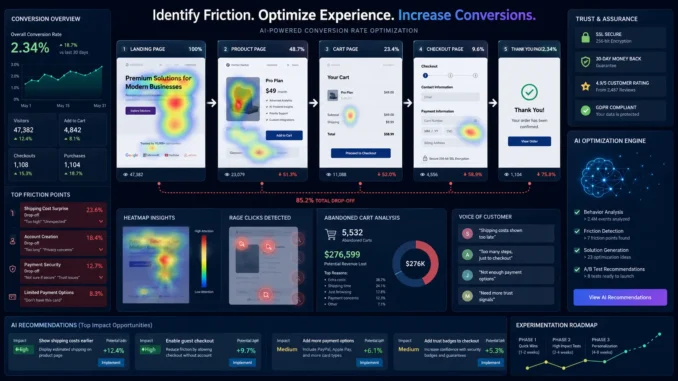
Why Visitors Click But Don’t Buy
Let’s start with a painful truth:
Clicks do not create revenue.
Conversions do.
The Illusion That Misleads Most Businesses
Here’s what many businesses celebrate:
- More traffic
- Higher click-through rates
- More ad impressions
Sounds impressive.
But here’s the real question:
Are those visitors buying?
If not… those numbers mean very little.
The Hidden Revenue Leak
Now consider this:
A visitor clicks your ad.
Lands on your page.
Reads a little.
Maybe even scrolls.
Then disappears.
No purchase.
No lead.
No revenue.
This happens thousands of times.
Quietly.
Expensively.
Why More Traffic Doesn’t Solve the Problem
Here’s the deal:
More traffic to a weak page simply creates more failure.
If 1,000 visitors don’t convert…
10,000 won’t magically fix it.
Because traffic magnifies existing problems.
It does not solve them.
The Real Problem: Psychological Resistance
This is where most businesses get it wrong.
They think visitors leave because:
- The offer is too expensive
- The product is not needed
- The audience is wrong
Sometimes true.
But often?
The issue is psychological friction.
What Happens Inside a Buyer’s Mind
Visitors ask themselves silent questions:
- “Can I trust this?”
- “Is this safe?”
- “Is this worth the risk?”
- “Do I need this right now?”
- “What if I make the wrong decision?”
If uncertainty wins…
The conversion dies.
Decision Fatigue Destroys Sales
Now here’s something critical:
Too many choices create exhaustion.
Too much information creates hesitation.
Too many CTAs create confusion.
This is decision fatigue.
And confused buyers rarely buy.
Trust Friction Is a Silent Killer
Let’s be honest:
If your page feels unclear…
Unprofessional…
Or suspicious…
Visitors leave instantly.
Trust friction comes from:
- Weak design
- Missing testimonials
- No guarantees
- Poor messaging
- Weak credibility signals
Trust is fragile.
And once lost… conversion disappears.
Risk Perception Controls Buying
Buying always feels risky.
Even for small purchases.
Business buyers think:
“What if this wastes budget?”
Consumers think:
“What if this disappoints me?”
If risk feels high… action stops.
Cart Abandonment Is Not Random
Here’s the breakthrough:
Visitors do not abandon because they’re unpredictable.
They abandon for reasons.
Usually psychological ones.
Examples:
- Unexpected pricing
- Complex checkout
- Forced account creation
- Low urgency
- Trust concerns
Every abandonment has a trigger.
The Shift That Changes Everything
Stop asking:
“How do we get more clicks?”
Start asking:
“Why are buyers hesitating?”
Because fixing hesitation grows revenue faster than buying more traffic.
CRO Is Buyer Psychology Optimization
This is the core idea:
Conversion optimization is not button testing.
It is buyer behavior engineering.
You optimize:
- Trust
- Clarity
- Confidence
- Decision ease
- Urgency
That’s what actually increases revenue.
What’s Next?
Now the real question is:
Which CRO strategies actually increase conversions predictably?
Because some changes barely matter.
Others can dramatically increase revenue.
High-Impact CRO Strategies That Increase Revenue Predictably
Let’s get practical:
You now understand that conversions are psychological.
So how do you improve them?
By removing resistance and increasing buyer confidence.
Quick CRO Strategy Breakdown
| Strategy | Psychological Trigger | Revenue Impact |
|---|---|---|
| Trust Signal Optimization | Risk reduction | Higher conversions |
| CTA Psychology | Action clarity | Better click-through |
| Friction Reduction | Cognitive ease | Lower abandonment |
| Form Simplification | Effort reduction | More completions |
| Social Proof Stacking | Validation psychology | Higher confidence |
| Offer Clarity | Decision confidence | Higher purchase intent |
| A/B Testing | Behavior optimization | Scalable growth |
1. Trust Signal Optimization – Reduce Buyer Fear
Here’s the deal:
Visitors buy when risk feels low.
They hesitate when uncertainty feels high.
Add trust signals:
- Testimonials
- Case studies
- Guarantees
- Secure payment indicators
- Recognizable brand logos
Trust lowers resistance instantly.
2. CTA Psychology – Make Action Obvious
Now consider this:
Weak calls-to-action create hesitation.
Generic buttons like:
“Submit”
Or
“Click Here”
Feel low-value.
Better alternatives:
- Get My Free Audit
- Start My Trial
- See My Growth Plan
Clear actions increase conversions.
3. Friction Reduction – Remove Decision Resistance
This is critical:
Every unnecessary step reduces conversions.
Common friction points:
- Too many clicks
- Slow load times
- Confusing layouts
- Complicated checkout
Less friction = more revenue.
4. Form Simplification – Reduce Effort
Here’s what kills leads:
Long forms.
Too many required fields.
Unclear questions.
Ask only what matters:
- Name
- Business need
Because effort reduces completion.
5. Social Proof Stacking – Validate Buyer Decisions
Now here’s powerful psychology:
People trust other people.
Especially when uncertain.
Stack validation:
- Testimonials
- Success metrics
- Review counts
- User numbers
- Case studies
Social proof reduces decision anxiety.
6. Offer Clarity – Eliminate Confusion
This is where many pages fail:
Visitors cannot quickly understand:
- What you offer
- Who it’s for
- Why it matters
- What happens next
Confusion destroys conversions.
Clarity sells.
7. Heatmap-Driven Optimization – Watch Real Behavior
Here’s something smart:
Buyers reveal friction through behavior.
Heatmaps show:
- Where users click
- Where they stop scrolling
- Where they hesitate
This turns guesswork into data.
8. A/B Testing Psychology – Optimize What Actually Works
Now scale scientifically:
Test variables like:
- Headlines
- CTAs
- Pricing presentation
- Form length
- Social proof placement
Because buyer behavior decides winners.
The Premium CRO Tech Stack
Now let’s connect strategy with monetization:
1. CRO Platforms – Conversion Experimentation
Run behavioral tests at scale.
- Best For: Revenue optimization
- Impact: Better conversion rates
2. Heatmap Tools – Buyer Visibility
See hesitation points visually.
- Best For: UX friction discovery
- Impact: Lower abandonment
3. Funnel Builders – Conversion Infrastructure
Structure optimized buyer journeys.
- Best For: Funnel performance
- Impact: Better sales flow
4. Analytics Platforms – Revenue Intelligence
Measure funnel performance precisely.
- Best For: Data insights
- Impact: Smarter optimization
5. AI Personalization Tools – Dynamic Conversion Boosting
Adapt experiences based on behavior.
- Best For: Relevance optimization
- Impact: Higher engagement
The Key Insight
CRO is not about random tweaks.
It is structured buyer psychology optimization.
So Why Do Buyers Actually Hesitate?
This is where it gets deeper.
Because every abandoned cart…
Every dropped form…
Every lost sale…
Has a psychological explanation.
The Psychology Behind Conversion Decisions (Why Buyers Hesitate Before Buying)
Here’s the truth:
Buyers do not abandon randomly.
They leave because something psychological stops them.
Every Conversion Has an Emotional Barrier
Let’s start here:
Buying is never purely logical.
Even business purchases.
Because every decision carries risk.
And risk creates hesitation.
That hesitation is where conversions die.
Cognitive Overload Creates Paralysis
Now consider this:
Too much information overwhelms the brain.
Too many choices create stress.
Too many comparisons create uncertainty.
This is choice paralysis.
When the brain feels overloaded…
It chooses the easiest option:
Do nothing.
Risk Aversion Controls Buyer Behavior
This is critical:
People fear making bad decisions.
More than they desire making good ones.
Buyers think:
- “What if this doesn’t work?”
- “What if I waste money?”
- “What if this creates problems?”
The higher the perceived risk…
The lower the conversion probability.
Trust Psychology Decides the Sale
Here’s the deal:
Trust is not optional.
It is foundational.
If buyers detect uncertainty:
- Poor design
- Weak messaging
- No proof
- Missing transparency
The brain flags danger.
And exits.
Commitment Friction Kills Momentum
Now here’s a subtle issue:
Every conversion asks for commitment.
Money.
Contact details.
Time.
Attention.
If commitment feels too large too soon…
Buyers resist.
This is why smaller asks often convert better.
The Cart Abandonment Psychology
Let’s be honest:
Cart abandonment is rarely about forgetting.
It is usually hesitation.
Common psychological triggers:
- Unexpected fees
- Weak urgency
- Complex checkout
- Low trust
- Comparison shopping behavior
Every abandoned cart reveals hidden resistance.
Form Drop-Off Behavior
Now think about lead generation forms.
Why do buyers quit halfway?
Because forms create psychological effort.
Questions trigger thoughts like:
- “Why do they need this?”
- “Will I get spammed?”
- “Is this worth finishing?”
Effort + uncertainty = abandonment.
Urgency Without Trust Backfires
This is important:
Urgency can increase conversions.
But fake urgency destroys trust.
Buyers detect manipulation quickly.
So urgency must feel credible.
Not forced.
The Buyer Confidence Formula
Conversions happen when buyers feel:
- Safe
- Clear
- Confident
- Validated
- Low risk
That emotional state drives action.
The Momentum Principle
Here’s the breakthrough:
Conversions are easier when buyers are already moving.
Momentum matters.
Small positive steps create bigger commitments.
This is why micro-conversions work so well.
The Core Insight
Every lost conversion has a behavioral explanation.
Not a random one.
Find the psychological barrier…
And revenue improves.
The Shift That Changes Everything
Stop asking:
“Why didn’t they buy?”
Start asking:
“What emotional friction stopped them?”
Because hesitation has patterns.
And patterns can be optimized.
So How Do You Build a Predictable CRO System?
This is where everything becomes actionable.
Because insight without systems does not scale.
Now let’s build the revenue optimization framework next.
How to Build a CRO System That Predictably Improves Revenue
Now let’s turn buyer psychology into measurable growth:
You understand hesitation.
You see why buyers abandon.
But here’s what matters most:
Building a repeatable conversion optimization system.
The Biggest CRO Mistake
Let’s be honest:
Most businesses guess.
They change:
- Button colors
- Headlines
- Layouts
- Offers
Without understanding buyer behavior.
That’s not optimization.
That’s random experimentation.
The Predictable CRO Framework
Here’s the system:
Observe → Identify Friction → Optimize → Test → Scale
This is how serious businesses grow revenue efficiently.
Step 1: Observe (Watch Real Buyer Behavior)
Start here:
You cannot fix what you cannot see.
Analyze behavior data:
- Heatmaps
- Session recordings
- Click tracking
- Funnel analytics
Because buyers reveal exactly where they struggle.
Step 2: Identify Friction (Find Conversion Killers)
This is where profitability hides.
Look for barriers:
- Confusing messaging
- Weak trust signals
- Long forms
- Poor CTA placement
- Unexpected costs
Each friction point leaks revenue.
Step 3: Optimize (Reduce Psychological Resistance)
Now improve the experience.
Make buying easier:
- Simplify copy
- Strengthen trust proof
- Reduce effort
- Clarify offers
- Improve urgency
Because easier decisions convert better.
Step 4: Test (Validate Buyer Behavior)
This is critical:
Never assume what works.
Test systematically:
- Headlines
- CTA wording
- Pricing display
- Checkout flow
- Social proof placement
Behavior decides winners.
Step 5: Scale (Double Down on Revenue Drivers)
Now maximize ROI.
Once a winning change appears:
- Expand traffic
- Apply insights elsewhere
- Increase investment strategically
Optimization compounds over time.
The CRO Revenue Flywheel
Here’s how it scales:
- Better observation → clearer insights
- Clearer insights → smarter optimization
- Smarter optimization → higher conversions
- Higher conversions → lower acquisition costs
- Lower costs → stronger profitability
And the cycle keeps improving.
The 80/20 Rule of CRO
You do not need hundreds of experiments.
You need high-impact improvements.
Focus on:
- Trust signals
- Offer clarity
- Friction reduction
- Checkout simplicity
These usually create the biggest gains.
The Identity Shift That Changes Everything
Let’s reframe your thinking:
You’re not optimizing web pages.
You’re optimizing human decisions.
And optimized decisions create predictable revenue growth.
From Guesswork to Revenue Engineering
This is the final insight:
More traffic is expensive.
Better conversions are profitable.
Because the right CRO system:
- Reduces hesitation
- Builds trust
- Improves buyer confidence
- Increases revenue per visitor
That is scalable business growth.
Your Next Step
Start today:
- Review your highest-traffic landing page
- Identify one major friction point
- Improve one trust signal
- Run one A/B test this week
That’s it.
Because CRO is not design tweaking.
It is behavioral revenue optimization.
And once buyer psychology and testing align…
Your revenue will not just improve.
It will scale efficiently.