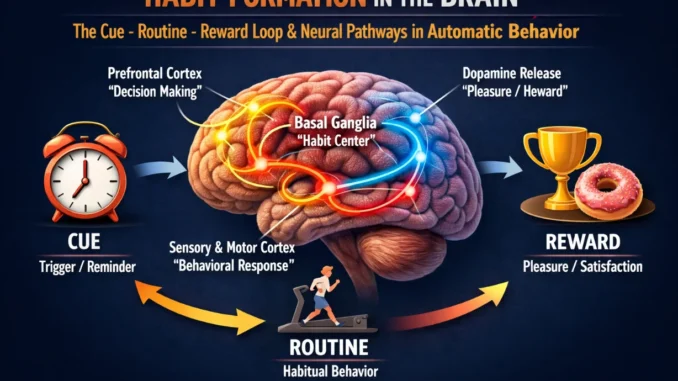
Habits form when the brain links a specific cue to a repeated behavior and reinforces it with a reward. Over time, this loop becomes automatic through changes in neural pathways and activity in the basal ganglia. Instead of relying on conscious decisions, the brain shifts control to faster, energy-efficient systems that run behaviors on autopilot.
But that’s only part of the story. Most explanations stop at the “habit loop.” In reality, habits are shaped by dopamine signals, prediction errors, and identity-driven behavior. This is why some habits stick effortlessly while others fail, even when motivation is high.
To understand how habits really form, you need to look at both psychology and brain science. Once you see how the system works, you can start to control it.
What Is a Habit in Psychology?
In psychology, a habit is a behavior that becomes automatic through repetition and consistent context. Instead of being driven by conscious decisions, habits are triggered by cues and executed with minimal mental effort. This shift allows the brain to conserve energy and operate more efficiently.
At the beginning, every behavior requires attention. You think about what to do, when to do it, and how to do it. But as the behavior repeats in the same context, the brain starts to “chunk” the process into a single unit. Over time, the action moves from deliberate control to automatic execution.
This is why habits feel effortless. You don’t actively decide to brush your teeth every morning or check your phone when it buzzes. The behavior is already wired into your system, waiting for the right trigger.
There’s an important distinction here. Habits are not the same as routines. A routine can require effort and intention, while a habit runs with little to no conscious input. The goal of habit formation is to convert effortful routines into automatic behaviors.
From a survival standpoint, this makes perfect sense. The brain is constantly trying to save energy. By turning repeated actions into habits, it frees up cognitive resources for new problems, decisions, and threats.
The Habit Loop Explained (Cue, Routine, Reward)
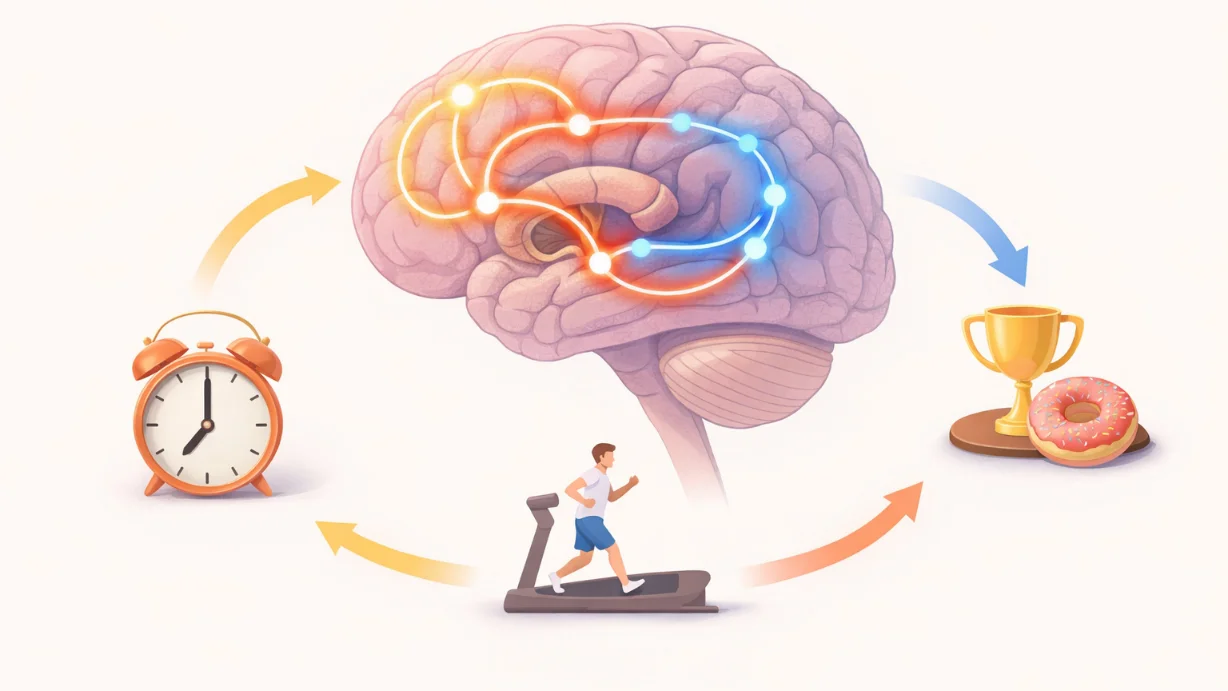
Most habits follow a three-part psychological pattern known as the habit loop: cue, routine, and reward. This model explains how behaviors become automatic over time. But while it sounds simple, the real power lies in how these elements interact inside your brain.
What Is a Cue?
A cue is the trigger that tells your brain to initiate a behavior. It can be external, like a time of day or a specific location, or internal, like a feeling or mental state. For example, boredom can trigger scrolling on your phone, while waking up can trigger making coffee.
Over time, the brain learns to associate these cues with specific actions. The stronger the association, the less conscious thought is required. Eventually, the cue alone is enough to start the behavior automatically.
What Is the Routine?
The routine is the behavior itself. It can be physical, like going for a run, or mental, like worrying or overthinking. This is the part most people focus on when trying to change habits, but it’s only one piece of the loop.
What matters more is consistency. When the same routine follows the same cue repeatedly, the brain begins to treat them as a single pattern rather than separate steps.
What Is the Reward?

The reward is what reinforces the habit. It tells the brain, “This behavior is worth remembering.” But here’s the nuance most people miss: the reward isn’t just about pleasure. It’s about expectation.
Your brain releases dopamine not only when you receive a reward, but when you anticipate it. If the outcome matches or exceeds what your brain توقعs, the habit strengthens. If it doesn’t, the loop weakens. This process is known as prediction error, and it plays a critical role in whether a habit sticks or fades.
Once the loop is established, the brain starts to run it automatically. The cue appears, the routine follows, and the reward reinforces the cycle—often without you even noticing.
What Happens in Your Brain When Habits Form?
Habit formation isn’t just behavioral. It’s neurological. As you repeat an action, your brain physically rewires itself to make that behavior faster, easier, and more automatic. This process involves specific brain regions, chemical signals, and changes in neural pathways.
Role of the Basal Ganglia
The basal ganglia is the part of the brain responsible for storing and executing habits. When a behavior is new, it’s controlled by the prefrontal cortex—the area responsible for decision-making and focus. This is why new habits feel effortful and mentally draining.
But with repetition, control shifts. The basal ganglia takes over, allowing the behavior to run automatically. This transfer reduces cognitive load, which is why habits require less attention over time.
Dopamine and Habit Formation
Dopamine plays a central role in reinforcing habits, but not in the way most people think. It’s not just a “reward chemical.” It’s a learning signal.
When you encounter a cue, your brain predicts a reward. If the outcome matches or exceeds that prediction, dopamine strengthens the neural connection between the cue and the behavior. If the reward falls short, the connection weakens. This constant adjustment is driven by prediction error.
Over time, dopamine shifts from the reward itself to the cue. This is why you start craving the behavior before it even happens. The anticipation becomes the driver.
Neural Pathways and Repetition
Every time you repeat a behavior, the neural pathway associated with it becomes stronger and more efficient. This process is often referred to as “neurons that fire together wire together.”
As these pathways strengthen, the brain requires less effort to activate them. Signals travel faster, decisions become automatic, and the behavior feels natural. This is how repetition transforms deliberate actions into habits.
In simple terms, habits are not just something you do. They are something your brain builds.
How Long Does It Really Take to Form a Habit?
You’ve probably heard that it takes 21 days to form a habit. It sounds clean and motivating. It’s also misleading.
One of the most cited studies on habit formation, conducted at University College London, found that it takes an average of 66 days for a behavior to become automatic. But that number is just an average. In reality, habit formation ranged from 18 days to over 250 days depending on the person and the behavior.
So why the difference? Because habits don’t form on a fixed timeline. They form based on consistency, context, and how rewarding the behavior feels.
Simple habits—like drinking a glass of water after waking up—can form relatively quickly. Complex habits—like exercising daily or changing your diet—take longer because they require more effort and resistance.
Frequency matters too. A behavior repeated daily builds faster than one done occasionally. But consistency is more important than perfection. Missing one day doesn’t break a habit. What matters is returning to the pattern before the brain starts to weaken the association.
There’s also a psychological factor most people overlook: emotional reward. If a behavior feels satisfying or meaningful, the brain reinforces it faster. If it feels forced or draining, progress slows—even if you stay consistent.
In other words, habits don’t form based on time alone. They form based on how often, how easily, and how strongly your brain connects the behavior to a positive outcome.
Why Some Habits Stick (And Others Fail)
Not all habits are created equal. Some behaviors become automatic with little effort, while others never seem to stick—no matter how motivated you feel. The difference isn’t willpower. It comes down to identity, environment, and friction.
One of the strongest drivers of lasting habits is identity. When a behavior aligns with how you see yourself, it becomes easier to repeat. For example, someone who identifies as “a healthy person” doesn’t just exercise occasionally—they act in ways that reinforce that identity. The habit becomes a reflection of who they believe they are.
This is why identity-based habits are so powerful. Instead of focusing on outcomes like “losing weight” or “being productive,” the focus shifts to becoming the type of person who naturally performs those behaviors.
Environment is another critical factor. Habits are highly sensitive to context. If your surroundings make a behavior easy, you’re more likely to repeat it. If they create resistance, the habit struggles to form. This is why small changes—like placing healthy food in visible areas or removing distractions—can have a disproportionate impact.
Then there’s friction. The brain is constantly looking for the path of least resistance. If a habit feels easy, it sticks. If it feels difficult, it fades. This applies in both directions. Increasing friction makes bad habits harder to perform, while reducing friction makes good habits easier to adopt.
Motivation plays a role, but it’s unreliable. It fluctuates based on mood, energy, and circumstances. Systems—identity, environment, and friction—are what make habits stable over time.
How to Build Good Habits (Psychology-Based Framework)
Building a habit isn’t about discipline. It’s about designing a system your brain can follow automatically. When you align your behavior with how habits actually form, the process becomes significantly easier and more predictable.
Step 1 – Start With a Clear Cue
Every habit begins with a trigger. The more specific and consistent the cue, the faster the habit forms. Instead of saying “I’ll exercise more,” anchor the behavior to something concrete like “After I wake up, I’ll do 10 minutes of stretching.”
This is where habit stacking becomes effective. You attach a new behavior to an existing habit, using it as a reliable trigger. The brain already recognizes the pattern, so the new behavior integrates more easily.
Step 2 – Make the Behavior Easy
If a habit feels difficult, the brain resists it. Lowering the barrier to action increases the chances of repetition. Start small. A habit should feel almost too easy to fail.
Instead of committing to a full workout, start with putting on your shoes. Instead of reading for an hour, start with one page. These small actions reduce friction and help establish consistency.
Step 3 – Attach an Immediate Reward
The brain learns through reinforcement. If a behavior feels rewarding, it’s more likely to be repeated. The key is immediacy.
Long-term benefits like “better health” are too abstract for the brain to prioritize. You need a short-term reward—something that creates a positive emotional response right after the behavior. This could be as simple as a sense of progress, satisfaction, or completion.
Step 4 – Repeat in a Stable Context
Consistency in context is what turns actions into habits. Performing the same behavior in the same situation strengthens the association between cue and action.
Changing the environment too often slows this process. The brain has to relearn the pattern each time. Stability accelerates automation.
When these four elements align—clear cue, low friction, immediate reward, and consistent context—the brain begins to automate the behavior. That’s when a habit truly forms.
How to Break Bad Habits (Rewiring Behavior)
Breaking a bad habit isn’t about stopping behavior through sheer willpower. That rarely works long-term. Instead, it’s about disrupting the habit loop and replacing it with a new pattern the brain can adopt.
Every habit follows the same structure: cue, routine, reward. To break a habit, you need to intervene at one or more points in that loop.
The most effective starting point is the cue. If you remove or avoid the trigger, the behavior becomes less likely to occur. For example, if boredom leads to excessive phone use, changing your environment or limiting access to your device reduces the trigger’s impact.
But removing cues isn’t always possible. That’s where replacement becomes critical. The brain doesn’t respond well to empty gaps. If you try to eliminate a behavior without replacing it, the loop remains incomplete—and the old habit often returns.
Instead, keep the same cue but swap the routine. If stress triggers smoking, replace it with a different action that delivers a similar reward, such as walking, breathing exercises, or even a short distraction. The key is to satisfy the underlying need driving the behavior.
Increasing friction is another powerful strategy. When a habit becomes harder to perform, the brain is less likely to choose it. Small barriers—like logging out of apps, moving distractions out of reach, or adding extra steps—can significantly reduce automatic behavior.
Awareness also plays a role. Many bad habits run unconsciously. By bringing attention to the cue and the moment before the behavior, you create a window to interrupt the pattern.
In the end, breaking a habit isn’t about removal. It’s about rewiring. The goal is to build a new loop that the brain prefers over the old one.
The Hidden Truth About Habits Most People Miss
Most people think habits are fully automatic. Once formed, they run on autopilot with little control. That idea is only partially true.
Habits are automatic, but they are not permanent. They can weaken, strengthen, or even disappear depending on context, emotional state, and attention. This is why a habit that feels solid in one environment can break down completely in another.
Your brain doesn’t store habits as fixed programs. It stores them as patterns that are sensitive to change. If the cue disappears, the reward changes, or the context shifts, the habit can lose its grip.
Emotions play a bigger role than most people realize. Stress, boredom, and anxiety can override existing habits and trigger different behaviors. This is why people often fall back into old patterns during difficult periods, even after making progress.
There’s also a layer of conscious control that never fully disappears. Even strong habits can be interrupted if awareness is high enough in the moment between cue and action. That small window is where change happens.
This leads to an important insight: habits are stable, but not unbreakable. They are shaped continuously by your environment, your identity, and your internal state.
Understanding this changes how you approach behavior. Instead of trying to lock in perfect habits, you focus on maintaining systems that support them. Flexibility, not rigidity, is what makes habits last.
Frequently Asked Questions
How are habits formed in the brain?
Habits form when repeated behaviors strengthen neural pathways in the brain, particularly in the basal ganglia. Over time, the brain links a cue to a behavior and reinforces it with dopamine, making the action automatic and easier to repeat.
What is the habit loop in psychology?
The habit loop is a three-step process consisting of a cue, a routine, and a reward. The cue triggers the behavior, the routine is the action itself, and the reward reinforces the behavior, making it more likely to happen again.
How long does it take to build a habit?
On average, it takes about 66 days for a habit to form, but the timeline can vary widely depending on the complexity of the behavior, consistency, and how rewarding the habit feels.
What part of the brain controls habits?
The basal ganglia is the primary brain region responsible for storing and executing habits. It allows repeated behaviors to become automatic, reducing the need for conscious decision-making.
Can bad habits be broken permanently?
Bad habits can be changed, but they are rarely erased completely. Instead, they are replaced with new behaviors. By altering cues, increasing friction, and introducing alternative routines, the brain can adopt new patterns over time.
Are habits automatic or conscious?
Habits are mostly automatic, but they are not entirely outside conscious control. With enough awareness, it is possible to interrupt a habit loop and choose a different behavior.