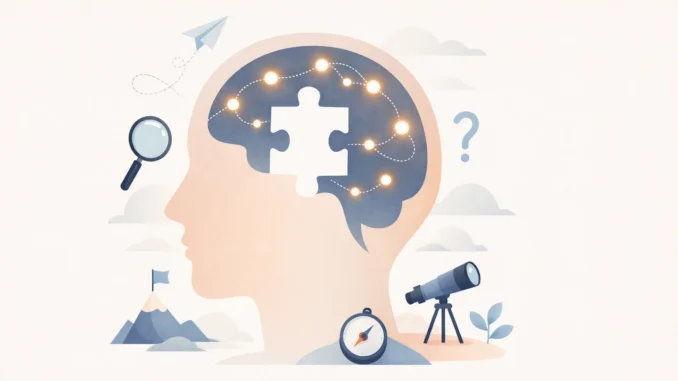
Why Curiosity Matters More Than Intelligence
Curiosity matters more than intelligence because it drives the desire to learn, explore, and adapt. While intelligence determines how well you process information, curiosity determines whether you seek it in the first place. Without curiosity, even the most intelligent mind remains underused.
At its core, curiosity is the force that pushes you into the unknown. It creates a gap between what you know and what you want to know—and your brain is wired to close that gap. This is why curious people naturally learn faster, think deeper, and grow more consistently over time.
Most people assume success comes from being “smart.” In reality, it comes from staying curious long enough to keep learning. Once you understand how curiosity works, you can use it deliberately—not just as a trait, but as a skill.
What Is Curiosity in Psychology?
In psychology, curiosity is defined as the intrinsic desire to seek out new information, experiences, and understanding. It’s not driven by external rewards like money or recognition. Instead, it comes from an internal need to reduce uncertainty and make sense of the world.
At its core, curiosity is triggered by a gap between what you know and what you want to know. This is often called the “knowledge gap.” When the brain detects this gap, it creates a sense of tension—an urge to resolve it by learning something new.
This is why curiosity feels almost uncomfortable at times. That feeling of “I need to know” isn’t random. It’s a built-in psychological mechanism designed to push you toward discovery.
There’s an important distinction between curiosity and intelligence. Intelligence is the ability to process and apply information. Curiosity is the motivation to seek it out in the first place. One determines capacity. The other determines direction.
Without curiosity, intelligence has no fuel. A highly intelligent person who never asks questions or explores new ideas will eventually plateau. On the other hand, a curious person continuously expands their knowledge, often outperforming those who rely on intelligence alone.
From a behavioral perspective, curiosity is what initiates learning. It’s the starting point of growth, not the result of it.
Why Curiosity Is Important for Learning and Growth
Curiosity is the engine behind meaningful learning. It doesn’t just help you gather information—it changes how deeply you understand and retain it. When curiosity is active, the brain becomes more engaged, focused, and receptive to new ideas.
Curiosity Drives Deeper Learning
When you’re curious, you don’t just accept information at face value. You ask questions, look for connections, and explore beyond the surface. This leads to deeper understanding rather than passive memorization.
Instead of learning “what,” curiosity pushes you to understand “why” and “how.” That shift alone transforms shallow knowledge into real insight.
It Improves Memory and Retention
Curiosity has a direct impact on memory. When something captures your interest, your brain prioritizes it. You’re more likely to remember information that you actively wanted to learn compared to something you were forced to study.
This happens because curiosity increases attention and engagement, which strengthens how information is encoded in the brain. In simple terms, the more curious you are, the easier it is to remember what you learn.
It Fuels Creativity and Problem-Solving
Curiosity exposes you to new ideas, perspectives, and possibilities. This creates a wider pool of information for your brain to draw from when solving problems.
Creative thinking doesn’t come from intelligence alone. It comes from making connections between different pieces of knowledge. Curious people naturally collect more inputs, which increases their ability to think creatively and adapt to new challenges.
Over time, this creates a compounding effect. The more curious you are, the more you learn. The more you learn, the more connections you can make. And the more connections you make, the more valuable your thinking becomes.
What Happens in Your Brain When You Feel Curious?
Curiosity isn’t just a feeling. It’s a neurological process that activates specific systems in your brain designed to drive learning and exploration. When curiosity is triggered, your brain shifts into a state that makes absorbing information easier and more rewarding.
Dopamine and the “Knowledge Gap”
When you encounter something you don’t fully understand, your brain detects a gap between what you know and what you want to know. This gap creates tension—and your brain responds by releasing dopamine.
Dopamine is often called the “reward chemical,” but in this context, it acts as a motivation signal. It pushes you to seek out the missing information. The bigger and more intriguing the gap, the stronger the drive to resolve it.
Curiosity as a Reward System
What makes curiosity powerful is that the act of learning itself becomes rewarding. As you get closer to an answer, your brain reinforces the behavior, making you more likely to continue exploring.
This is why people can spend hours researching a topic they’re interested in without feeling drained. The brain treats learning as a rewarding activity, not a chore.
Why Uncertainty Feels Compelling
Uncertainty is uncomfortable, but it’s also what triggers curiosity. When something is partially known but not fully understood, your brain becomes highly engaged.
If something is too predictable, you lose interest. If it’s too complex, you feel overwhelmed. Curiosity lives in the middle—where there’s just enough uncertainty to pull you in.
This balance explains why curiosity is so effective for learning. It keeps your brain alert, motivated, and focused on closing the gap between the known and the unknown.
Why Curiosity Declines as You Get Older
Children are naturally curious. They ask questions constantly, explore without hesitation, and learn through trial and error. But as people get older, that curiosity often fades. Not because it disappears, but because it gets suppressed.
One of the main reasons is education. Traditional learning environments tend to reward correct answers over asking questions. Over time, this conditions people to focus on outcomes rather than exploration. Curiosity becomes less about discovery and more about performance.
Another factor is fear of being wrong. As adults, people become more aware of judgment. Asking questions can feel risky, especially in social or professional settings. This creates hesitation, which slowly reduces curiosity-driven behavior.
Routine also plays a role. The more predictable your environment becomes, the fewer opportunities there are for curiosity to activate. When everything feels familiar, the brain has fewer reasons to explore.
There’s also a shift toward efficiency. Adults prioritize speed and results, often skipping the exploratory phase entirely. But curiosity requires time, uncertainty, and a willingness to not know.
The important insight is this: curiosity doesn’t disappear with age. It gets buried under habits, expectations, and environments that don’t support it. When those constraints are removed, curiosity can return quickly.
Curiosity vs Intelligence: What Matters More?
Intelligence determines how well you can process information. Curiosity determines whether you seek that information at all. And in the long run, that difference matters more than most people think.
A highly intelligent person who lacks curiosity may rely on what they already know. They solve familiar problems efficiently but rarely expand beyond their current understanding. Over time, this leads to stagnation.
On the other hand, a curious person constantly explores new ideas, asks better questions, and exposes themselves to unfamiliar situations. Even if they start with less knowledge, they continue to grow. That growth compounds.
This is why curiosity often outperforms intelligence in real-world scenarios. It drives continuous learning, which is more valuable than static ability. Intelligence gives you an advantage at a moment in time. Curiosity ensures you keep improving over time.
There’s also a directional difference. Intelligence helps you go faster. Curiosity helps you go further. Without direction, speed has limited value.
In many cases, the most successful people aren’t the ones who started out the smartest. They’re the ones who stayed curious long enough to keep learning, adapting, and evolving.
How to Develop Curiosity (Practical Framework)
Curiosity isn’t something you either have or don’t have. It’s a skill that can be developed with the right approach. The key is to create conditions that trigger your brain’s natural desire to explore.
Ask Better Questions
Curiosity starts with questions. But not all questions are equal. Instead of asking surface-level questions, go deeper. Replace “What is this?” with “Why does this work this way?” or “What would happen if this changed?”
Better questions create stronger knowledge gaps, which naturally pull your attention and drive learning.
Expose Yourself to New Inputs
Curiosity needs novelty. If you consume the same information every day, your brain has nothing new to explore. Introducing new ideas, perspectives, or environments creates fresh gaps for curiosity to act on.
This could be as simple as reading outside your usual interests, having conversations with different people, or exploring unfamiliar topics.
Embrace Uncertainty Instead of Avoiding It
Most people avoid situations where they don’t have answers. But curiosity lives in uncertainty. If you always stay within what you already understand, curiosity has no reason to activate.
Learning to tolerate not knowing—without immediately seeking closure—keeps curiosity alive longer and deeper.
Reduce Fear of Judgment
One of the biggest blockers of curiosity is the fear of looking uninformed. This stops people from asking questions or exploring openly.
Shifting your mindset from “I should know this” to “I want to understand this” removes that pressure and makes curiosity easier to express.
When these habits are practiced consistently, curiosity becomes automatic. Not because you force it, but because your environment and mindset support it.
The Hidden Power of Curiosity Most People Ignore
Curiosity isn’t just about learning new things. It changes how you experience the world. When curiosity is active, even ordinary situations become engaging because your brain is constantly searching for meaning, patterns, and possibilities.
One of its most overlooked benefits is how it reduces boredom. Boredom often comes from familiarity and repetition. But curiosity reframes the same environment by asking new questions. Instead of seeing what’s obvious, you start noticing what’s overlooked.
This shift has a deeper effect on how you think. Curious people don’t just consume information—they interact with it. They challenge assumptions, explore alternatives, and stay mentally flexible. This flexibility is what allows them to adapt in uncertain or changing situations.
Curiosity also plays a quiet role in innovation. Most breakthroughs don’t start with answers. They start with questions. The willingness to explore something unclear or unresolved is what leads to new ideas.
There’s also a long-term impact. Curiosity keeps the brain active. It encourages continuous learning, which helps maintain cognitive sharpness over time. In that sense, curiosity isn’t just a learning tool—it’s a way to keep your thinking alive.
The real power of curiosity is this: it transforms how you approach both knowledge and life. Instead of waiting for answers, you actively seek them. And that shift changes everything.