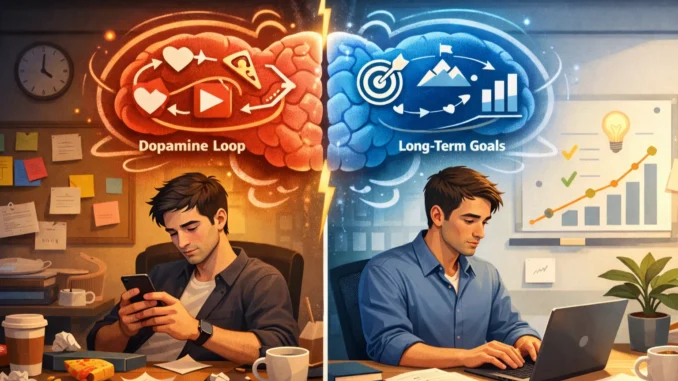
Why You Procrastinate (Even When You Know You Shouldn’t)
Let’s start with a hard truth:
Procrastination is not laziness.
It’s a conflict inside your brain.
The Hidden Battle in Your Mind
Here’s what it feels like:
You know what you should do.
You plan to do it.
You even want to do it.
But somehow…
You don’t.
Instead, you:
- Check your phone
- Scroll endlessly
- Do something easier
And then comes the worst part:
The guilt.
The Real Problem Isn’t Discipline
Most people think:
“I just need more willpower.”
But that’s not true.
Because if it were…
You wouldn’t repeat the same pattern.
Over and over again.
Procrastination Is Emotional, Not Logical
Here’s the deal:
Your brain doesn’t avoid tasks.
It avoids feelings.
Like:
- Stress
- Uncertainty
- Boredom
- Overwhelm
So when a task feels uncomfortable…
Your brain looks for escape.
The Instant Relief Trap
Now consider this:
When you avoid a task…
You feel better.
Immediately.
This creates a loop:
- Task feels hard
- You avoid it
- You feel relief
And your brain learns:
“Avoiding = feeling better.”
So it repeats the behavior.
Dopamine: The Real Driver
Here’s what’s happening chemically:
Your brain rewards easy actions.
Scrolling.
Watching.
Clicking.
These give instant dopamine.
But hard tasks?
They delay reward.
So your brain chooses the easier option.
Decision Fatigue Makes It Worse
Now add this:
You make hundreds of decisions daily.
Your brain gets tired.
This is decision fatigue.
So when it’s time to focus…
You choose what’s easiest.
Not what’s important.
The Overwhelm Effect
Here’s another trigger:
Big tasks feel heavy.
Unclear.
Stressful.
So your brain delays them.
Not because you can’t do them.
But because they feel too big to start.
The Breakthrough Insight
So instead of asking:
“Why am I so lazy?”
Ask this:
“What feeling am I trying to avoid?”
Because that’s the real cause.
Procrastination Is Emotional Regulation
This is the key idea:
Procrastination = avoiding discomfort.
Not avoiding work.
And once you understand that…
You stop blaming yourself.
And start fixing the real problem.
From Self-Blame to Self-Awareness
Everything changes here:
You’re not broken.
Your brain is just trying to protect you.
From discomfort.
From stress.
From effort.
What’s Next?
Now the real question is:
How do you actually break this cycle?
Because understanding the problem…
Is only the first step.
High-Impact Anti-Procrastination Strategies (That Actually Work)
Let’s get practical:
You now understand why procrastination happens.
So how do you stop it?
By changing how your brain experiences tasks.
Quick Strategy Breakdown
| Strategy | Psychological Trigger | Impact |
|---|---|---|
| Task Chunking | Reduces overwhelm | Faster starts |
| Time Blocking | Creates structure | Improved focus |
| Environment Design | Removes distractions | Less avoidance |
| Dopamine Control | Limits instant rewards | Better discipline |
| Accountability | External pressure | Higher completion rate |
1. Task Chunking – Make It Too Small to Avoid
Here’s the deal:
Big tasks feel intimidating.
So your brain delays them.
The solution?
Break everything down.
Instead of:
“Write report”
Do this:
- Open document
- Write first sentence
- Create outline
Smaller steps feel easier.
And easier tasks get started.
2. Time Blocking – Remove Decision Fatigue
Now consider this:
When you don’t plan your time…
Your brain defaults to easy tasks.
So schedule your focus:
- 9:00–9:30 → Work on task
- 9:30–9:45 → Break
No thinking.
No deciding.
Just following a plan.
3. Environment Design – Control Your Surroundings
Here’s something powerful:
Your environment shapes your behavior.
If distractions are visible…
You’ll use them.
So remove them:
- Silence notifications
- Keep phone out of reach
- Use clean workspace
Less distraction = less procrastination.
4. Dopamine Control – Delay Instant Rewards
This is critical:
Your brain prefers easy rewards.
So limit them:
- Avoid social media before work
- Delay entertainment
- Work first, reward later
This resets your reward system.
And makes focus easier.
5. Accountability – Use External Pressure
Here’s the truth:
You’re more likely to act…
When someone else is involved.
So create accountability:
- Tell someone your goal
- Work with a partner
- Use deadlines publicly
Because pressure creates action.
The Tools That Make This Easier
Now let’s connect strategy with execution:
1. Task Management Tools – Organize Your Work
Tools like task managers break work into steps.
- Best For: Task clarity
- Impact: Reduced overwhelm
2. Focus Tracking Apps – Measure Your Time
These tools show where your time goes.
- Best For: Awareness
- Impact: Better focus habits
3. Distraction Blockers – Eliminate Temptation
Apps block time-wasting sites.
- Best For: Focus sessions
- Impact: Fewer interruptions
4. AI Schedulers – Automate Your Day
AI tools plan your schedule automatically.
- Best For: Productivity optimization
- Impact: Less decision fatigue
5. Habit Trackers – Build Consistency
Track progress and build streaks.
- Best For: Habit building
- Impact: Long-term discipline
The Key Insight
Strategies reduce resistance.
Tools support behavior.
But action comes from starting small.
So What’s Actually Happening Inside Your Brain?
This is where it gets even deeper.
Because procrastination is not random.
It’s neurological.
The Science Behind Procrastination (What Your Brain Is Actually Doing)
Here’s the truth:
Your brain is not trying to make you fail.
It’s trying to make you feel better.
The Two Systems in Your Brain
Let’s break it down simply:
Your brain has two competing systems:
- Limbic system: Seeks pleasure, avoids pain
- Prefrontal cortex: Plans, focuses, thinks long-term
And here’s the problem:
The limbic system is faster.
Stronger.
More emotional.
So it often wins.
The Instant vs Future Conflict
Now consider this:
Your prefrontal cortex says:
“Work now for future success.”
But your limbic system says:
“Avoid discomfort. Feel good now.”
And in the moment?
“Now” usually wins.
Dopamine Loops: Why Distractions Are So Powerful
Here’s what’s happening chemically:
Every time you:
- Check your phone
- Scroll social media
- Watch short videos
Your brain releases dopamine.
This creates a reward loop:
Action → Reward → Repeat
So your brain learns:
“This is easy. Do it again.”
And hard tasks?
They lose the competition.
Temporal Discounting: The Future Feels Less Important
This is a key concept:
Your brain discounts future rewards.
This is called temporal discounting.
So:
- $100 today feels better than $200 later
- Relaxing now feels better than working for future success
Even if the long-term reward is bigger.
Because the future feels abstract.
The Stress Response and Avoidance
Now add this:
When a task feels stressful…
Your brain treats it like a threat.
And triggers avoidance.
This creates:
- Delay
- Distraction
- Escape behavior
Because avoiding the task…
Reduces stress immediately.
The Effort Cost Problem
Here’s another factor:
Your brain evaluates effort.
If something feels too hard…
It avoids it.
Even if it’s important.
Because the brain prefers efficiency.
Not effort.
The Core Insight
Procrastination is not a failure of logic.
It’s a success of your brain’s survival system.
Choosing comfort.
Over effort.
In the short term.
The Shift That Changes Everything
Stop asking:
“Why can’t I focus?”
Start asking:
“How can I make this easier for my brain?”
Because your brain follows ease.
Not intention.
From Fighting Your Brain to Working With It
This is the breakthrough:
You don’t need to fight procrastination.
You need to redesign your environment and tasks.
So your brain naturally chooses action.
So How Do You Actually Stop Procrastinating Long-Term?
This is where everything comes together.
Because the solution is not motivation.
It’s a system.
How to Stop Procrastinating (A Simple System That Actually Works)
Now let’s turn insight into action:
You understand the psychology.
You see the brain conflict.
But here’s what matters most:
Building a system that works with your brain.
The Biggest Productivity Mistake
Let’s be honest:
Most people try to fix procrastination with willpower.
They say:
“I’ll just focus harder.”
“I’ll try to be disciplined.”
But that fails.
Because willpower is limited.
Systems are not.
The Anti-Procrastination System
Here’s a simple framework:
Reduce → Simplify → Start → Reinforce
Follow this… and procrastination fades.
Step 1: Reduce (Lower the Resistance)
Start here:
Your brain avoids effort.
So reduce it.
Make the task easier:
- Remove distractions
- Prepare your workspace
- Set clear next steps
Less friction = more action.
Step 2: Simplify (Make It Smaller)
Now shrink the task:
Don’t think about the whole project.
Just the first step.
Examples:
- Open the file
- Write one sentence
- Read one page
Because starting is the hardest part.
And small starts feel safe.
Step 3: Start (Use the 2-Minute Rule)
Here’s a powerful rule:
If it takes less than 2 minutes…
Do it now.
If it’s bigger…
Start for just 2 minutes.
That’s it.
Because once you begin…
Momentum takes over.
Step 4: Reinforce (Reward the Behavior)
This is critical:
Your brain repeats what feels good.
So reward progress:
- Take a break after focus
- Acknowledge completion
- Track your progress
Even small wins matter.
Because they build momentum.
The Momentum Effect
Here’s what happens next:
- Small action → reduced resistance
- Reduced resistance → easier continuation
- Continuation → progress
- Progress → motivation
And suddenly…
What felt hard becomes natural.
The 80/20 Rule of Productivity
You don’t need perfect focus.
You need consistent starts.
Focus on:
- Starting quickly
- Reducing friction
- Repeating the system
That drives most results.
The Identity Shift That Changes Everything
Let’s reframe your mindset:
You’re not “a procrastinator.”
You’re someone learning to manage your brain.
And that changes everything.
From Avoidance to Action
This is the final insight:
Procrastination doesn’t disappear overnight.
It fades through small wins.
Repeated daily.
Until action becomes automatic.
Your Next Step
Start right now:
- Pick one task
- Break it into one small step
- Work for 2 minutes
- Stop—or continue
That’s it.
Because action doesn’t come from motivation.
It comes from starting.
And once you align with how your brain works…
You won’t just beat procrastination.
You’ll control it.