Why Most “Simple Habits” Don’t Actually Improve Your Well-Being
Let’s start with a frustrating truth:
Most people don’t lack habits.
They lack results.
The Wellness Illusion
Here’s what usually happens:
You try healthy habits.
- Drink more water
- Exercise regularly
- Meditate daily
For a few days… it works.
You feel motivated.
In control.
Optimistic.
Then slowly… it fades.
The Real Problem Isn’t Discipline
Let’s be clear:
This is not about laziness.
Or lack of willpower.
The real problem is this:
You’re relying on motivation instead of systems.
Why Motivation Always Fails
Now consider this:
Motivation is emotional.
It changes daily.
Sometimes hourly.
So if your habits depend on how you feel…
They won’t last.
Because feelings are unstable.
Cognitive Overload: Too Many Habits, Too Fast
Here’s another issue:
People try to change everything at once.
Morning routine.
Workout plan.
Diet.
Meditation.
And it becomes overwhelming.
This is cognitive overload.
And when the brain feels overwhelmed…
It shuts down.
The Habit Stacking Trap
You’ve probably heard this advice:
“Stack multiple habits together.”
Sounds efficient.
But here’s the problem:
Too many stacked habits…
Create friction.
And friction kills consistency.
The Missing Piece: Feedback
Now here’s what most people miss:
Habits need feedback.
Without it…
Your brain loses interest.
Because there’s no visible progress.
No reward.
No reason to continue.
Why “Simple Habits” Don’t Feel Effective
Let’s simplify it:
If a habit doesn’t:
- Feel easy
- Show progress
- Create reward
Your brain won’t keep it.
No matter how “good” it is.
The Breakthrough Shift
So instead of asking:
“What habits should I add?”
Ask this:
“What system makes habits automatic?”
Because systems create consistency.
Not motivation.
Habits Are Behavior Systems
This is the key idea:
Habits are not random actions.
They are systems.
Built from:
- Triggers
- Actions
- Rewards
And when this system is missing…
Habits fail.
From Random Effort to Structured Change
Once you understand this…
Everything changes.
You stop trying harder.
And start designing smarter.
Because well-being is not about effort.
It’s about structure.
What’s Next?
Now the real question is:
Which daily habits actually improve your mental health and well-being?
Because not all habits work.
Some drain you.
Others transform you.
High-Impact Daily Habits That Actually Improve Your Well-Being
Let’s get practical:
You now understand why most habits fail.
So what actually works?
Simple habits… built the right way.
Quick Habit Breakdown
| Habit | Psychological Trigger | Benefit |
|---|---|---|
| Morning Mental Reset | Clarity & release | Reduced stress |
| Daily Movement | Energy activation | Better mood & focus |
| Digital Detox | Cognitive relief | Lower anxiety |
| Sleep Routine | Recovery loop | Improved mental health |
| Daily Reflection | Feedback loop | Self-awareness |
1. Morning Mental Reset – Clear Your Mind First
Here’s the deal:
Your brain wakes up full.
Thoughts.
Stress.
Unfinished ideas.
If you don’t clear it…
It carries into your day.
So start with a reset:
- Write down your thoughts (journaling)
- List priorities
- Do a quick “mind dump”
This reduces mental noise.
And creates clarity.
2. Daily Movement – Energy Before Motivation
Now consider this:
You don’t need a full workout.
You need movement.
Even 5–10 minutes:
- Stretching
- Walking
- Light exercise
Movement signals your brain:
“We’re active.”
And that boosts energy instantly.
3. Digital Detox – Reduce Cognitive Overload
Here’s a hidden problem:
Your brain is constantly stimulated.
Notifications.
Social media.
Information overload.
This creates stress.
Even if you don’t notice it.
So create boundaries:
- No phone first 30 minutes
- Scheduled “offline” time
- Limit unnecessary apps
Less input… more clarity.
4. Sleep Optimization – The Foundation Habit
This is critical:
No habit works if you’re exhausted.
Sleep is the foundation.
Improve it by:
- Consistent sleep schedule
- Reducing screen time before bed
- Creating a calming routine
Better sleep = better everything.
5. Daily Reflection – Close the Loop
Here’s what most people skip:
Reflection.
Without it…
You repeat the same patterns.
So take 2 minutes:
- What went well?
- What didn’t?
- What can improve?
This creates a feedback loop.
And feedback drives growth.
The Tools That Make This Easier
Now let’s connect habits with execution:
1. Meditation Apps – Reduce Stress Fast
Apps like meditation platforms guide your mind.
- Best For: Mental clarity
- Impact: Lower anxiety
2. Journaling Apps – Organize Your Thoughts
Digital journals help structure thinking.
- Best For: Mind clarity
- Impact: Reduced overwhelm
3. Wearable Trackers – Monitor Your Health
Track sleep, steps, and activity.
- Best For: Physical awareness
- Impact: Behavior improvement
4. Sleep Apps – Optimize Recovery
Improve sleep quality with data insights.
- Best For: Sleep tracking
- Impact: Better recovery
5. AI Habit Trackers – Build Consistency
These tools help you stay consistent.
- Best For: Habit tracking
- Impact: Long-term success
The Key Insight
Habits improve well-being.
Tools make them easier.
But consistency creates results.
So Why Do People Still Fail to Stick to Habits?
This is where psychology goes deeper.
Because even good habits fail…
If they’re not designed correctly.
The Psychology Behind Habits That Actually Stick (Why Some Work and Others Fail)
Here’s the truth:
Most habits don’t fail because they’re bad.
They fail because they’re poorly designed.
Motivation vs System Design
Let’s clarify something:
Motivation gets you started.
Systems keep you going.
If your habit depends on feeling motivated…
It won’t last.
Because motivation is temporary.
The Habit Loop (The Core of Behavior)
Every habit follows a simple pattern:
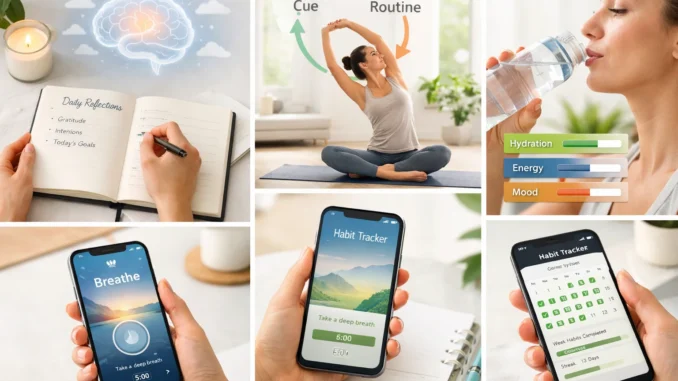
Cue → Action → Reward
Let’s break it down:
- Cue: Trigger that starts the habit
- Action: The behavior itself
- Reward: The benefit you feel
If one part is missing…
The habit breaks.
Why Most Habits Don’t Stick
Here’s what usually goes wrong:
- No clear trigger
- Too much effort required
- No immediate reward
So the brain says:
“This isn’t worth it.”
And stops.
Dopamine: The Real Driver of Habits
Now here’s something powerful:
Your brain repeats what feels rewarding.
This is driven by dopamine.
So if a habit feels good…
You’ll repeat it.
If it feels like effort…
You’ll avoid it.
The “Too Big” Problem
Let’s be honest:
Most habits fail because they’re too big.
Examples:
- “I’ll work out 1 hour daily”
- “I’ll meditate 30 minutes every day”
Sounds good.
But feels heavy.
And heavy habits don’t last.
The Power of Tiny Habits
Here’s the better approach:
Make habits so small…
They feel effortless.
Examples:
- 1 minute of journaling
- 5 push-ups
- 2 minutes of reflection
Because small habits remove resistance.
And consistency beats intensity.
Identity-Based Habits
This is where it gets deeper:
Lasting habits are tied to identity.
Not outcomes.
Instead of:
“I want to be healthier”
Think:
“I am someone who takes care of my mental health.”
Because identity drives behavior.
The Feedback Loop That Builds Consistency
Here’s what makes habits stick:
Progress.
Even small progress.
So when you:
- Track habits
- See streaks
- Notice improvement
Your brain gets rewarded.
And continues.
The Core Insight
Habits don’t fail because you’re inconsistent.
They fail because they’re too hard.
Too unclear.
Or not rewarding enough.
The Shift That Changes Everything
Stop asking:
“How do I stay motivated?”
Start asking:
“How do I make this habit easier?”
Because easy habits get repeated.
And repeated habits create results.
So How Do You Build a System That Actually Works?
This is where everything becomes actionable.
Because once you understand behavior…
You can design your daily life.
Let’s build a simple habit system next.
How to Build a Daily Habit System That Actually Improves Your Life
Now let’s turn insight into real change:
You understand the psychology.
You see why habits fail.
But here’s what matters most:
Building a system that works.
The Biggest Habit Mistake
Let’s be honest:
Most people try to change everything at once.
New routine.
New mindset.
New habits.
All at once.
And it collapses.
Because complexity kills consistency.
The Habit System That Works
Here’s a simple framework:
Simplify → Stack → Track → Reinforce
Follow this… and habits stick.
Step 1: Simplify (Start Smaller Than You Think)
Start here:
Make your habit so easy…
It feels almost pointless.
Examples:
- 1 minute of journaling
- 5 minutes of movement
- 1 deep breath session
Because small habits remove resistance.
And resistance is the real enemy.
Step 2: Stack (Attach to Existing Routines)
Now anchor your habit:
Don’t create new time slots.
Attach habits to what you already do.
Examples:
- After brushing teeth → journal
- After waking up → stretch
- After lunch → quick walk
This creates automatic triggers.
And automation creates consistency.
Step 3: Track (Make Progress Visible)
This is critical:
Your brain needs to see progress.
So track it:
- Habit trackers
- Simple checklists
- Daily streaks
Because visible progress = motivation.
Step 4: Reinforce (Reward the Behavior)
Here’s what most people skip:
Reward.
If a habit feels good…
You repeat it.
So reinforce it:
- Acknowledge completion
- Celebrate small wins
- Reflect on benefits
This builds a positive loop.
The Habit Flywheel
Here’s how it all connects:
- Easy habit → consistent action
- Consistent action → visible progress
- Progress → motivation
- Motivation → stronger habit
And the cycle continues.
The 80/20 Rule of Well-Being
You don’t need 10 habits.
You need 2–3 that work.
Focus on:
- Mental clarity (journaling/meditation)
- Physical movement
- Sleep quality
These drive most results.
The Identity Shift That Changes Everything
Let’s reframe your mindset:
You’re not “trying to build habits.”
You’re becoming someone who:
- Takes care of their mind
- Protects their energy
- Values their well-being
And identity drives consistency.
From Effort to Lifestyle
This is the final insight:
Well-being is not built through effort.
It’s built through systems.
Small actions.
Repeated daily.
Until they become automatic.
Your Next Step
Start today:
- Choose 1 small habit
- Attach it to an existing routine
- Track it for 7 days
- Notice the change
That’s it.
Because small systems…
Create big transformations.
And once your habits align with how your brain works…
Your well-being won’t just improve.
It will become automatic.