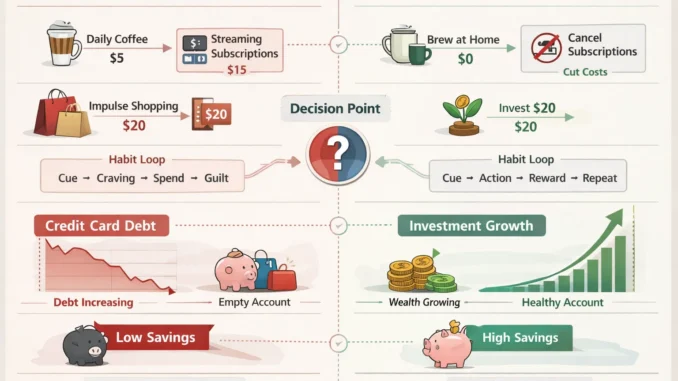
Why Small Financial Decisions Matter More Than Big Ones
Let’s start with a surprising truth:
Your financial future is not shaped by big decisions.
It’s shaped by tiny daily ones.
The Biggest Money Myth
Here’s what most people believe:
Wealth comes from:
- Big investments
- High income
- Major financial moves
So they focus on the big picture.
And ignore the small details.
But that’s where the problem begins.
The Invisible Financial Leak
Now consider this:
$5 here.
$10 there.
A subscription you forgot about.
A quick impulse purchase.
Individually?
They feel harmless.
But combined?
They quietly drain your future.
The Real Problem: Financial Blind Spots
Here’s the deal:
Small decisions don’t feel important.
So your brain ignores them.
This creates blind spots:
- Untracked spending
- Automatic habits
- Unnoticed patterns
And over time?
These patterns define your financial life.
Decision Fatigue: Why You Default to Easy Choices
Now here’s the psychology:
You make hundreds of decisions daily.
Your brain gets tired.
This is decision fatigue.
So instead of thinking carefully…
You choose what’s easy.
Convenient.
Instant.
And most of the time?
That means spending.
Present Bias: Why “Now” Wins Over “Later”
Here’s another hidden force:
Your brain values immediate rewards.
Over future benefits.
This is present bias.
So when faced with a choice:
$10 today… or $1,000 in the future?
The brain often chooses today.
Because it feels real.
Tangible.
Immediate.
Mental Accounting: The Money Illusion
Now consider this:
People treat money differently depending on context.
This is mental accounting.
For example:
- “It’s just a small expense”
- “I deserve this”
- “It’s only a few dollars”
These mental shortcuts justify spending.
Without seeing the bigger impact.
The Compound Effect of Small Decisions
Here’s where it gets powerful:
Small decisions don’t stay small.
They compound.
Daily spending becomes:
- Monthly patterns
- Yearly habits
- Long-term outcomes
And over time?
They shape your entire financial future.
The Breakthrough Shift
So instead of asking:
“What big move should I make?”
Ask this:
“What small decisions am I repeating daily?”
Because repetition creates results.
Your Financial Autopilot System
This is the key concept:
Your finances run on autopilot.
Built from habits.
Not intentions.
So if your daily habits are:
- Unconscious
- Untracked
- Reactive
Your financial future becomes the same.
From Big Decisions to Daily Behavior
Once you understand this…
Everything changes.
You stop chasing big wins.
And start fixing daily patterns.
Because that’s where real wealth is built.
What’s Next?
Now the real question is:
Which daily habits actually make the biggest financial difference?
Because not all habits are equal.
Some drain your money.
Others build it.
The Highest-Impact Daily Financial Habits (That Quietly Build Wealth)
Let’s get practical:
You now understand the problem—small decisions shape everything.
So how do you fix it?
By upgrading your daily habits.
Quick Habit Breakdown
| Habit | Psychological Trigger | Financial Impact |
|---|---|---|
| Track Expenses | Awareness | Stops hidden leaks |
| Automate Savings | Removes friction | Consistent wealth growth |
| Reduce Micro-Spending | Impulse control | Higher savings rate |
| Audit Subscriptions | Pattern awareness | Eliminates waste |
| Daily Check-Ins | Behavior reinforcement | Long-term discipline |
1. Track Expenses – Awareness Changes Everything
Here’s the deal:
You can’t fix what you don’t see.
Most people don’t know where their money goes.
They guess.
And guessing leads to leaks.
Instead:
- Track daily spending
- Categorize expenses
- Review patterns weekly
Because awareness creates control.
2. Automate Savings – Remove the Decision Completely
Now consider this:
Saving money requires discipline.
But discipline is unreliable.
So remove the need for it.
Automate:
- Monthly transfers to savings
- Investment contributions
- Emergency fund deposits
No decision.
No resistance.
Just progress.
3. Reduce Micro-Spending – The Silent Wealth Killer
Here’s something important:
Small expenses feel harmless.
But they add up fast.
Examples:
- Daily coffee
- Food delivery
- Impulse online purchases
You don’t need to eliminate them.
Just control them.
Because small leaks sink big ships.
4. Audit Subscriptions – The Hidden Money Drain
Let’s be honest:
You’re probably paying for things you don’t use.
Streaming services.
Apps.
Memberships.
They feel small.
But they stack.
So:
- Review subscriptions monthly
- Cancel unused services
- Downgrade unnecessary plans
Easy savings.
No lifestyle change needed.
5. Daily Financial Check-Ins – Build Awareness Loops
This is powerful:
Spend 2 minutes daily reviewing your money.
That’s it.
Look at:
- What you spent
- What you saved
- What changed
This creates a feedback loop.
And feedback drives better decisions.
The Tools That Make This Easy
Now let’s connect habits with execution:
1. Budgeting Apps – Your Financial Dashboard
Tools like budgeting apps track spending automatically.
- Best For: Expense tracking
- Impact: Full visibility
2. Wealth Tracking Platforms – See the Bigger Picture
These tools show your net worth over time.
- Best For: Long-term tracking
- Impact: Motivation & clarity
3. Investment Apps – Turn Small Money Into Growth
Start investing easily with micro-amounts.
- Best For: Beginners
- Impact: Compounding growth
4. Credit Monitoring Tools – Protect Your Financial Health
Track and improve your credit score.
- Best For: Financial optimization
- Impact: Better financial opportunities
5. AI Finance Assistants – Smarter Money Decisions
New tools help analyze and optimize spending.
- Best For: Automation & insights
- Impact: Faster improvements
The Key Insight
Habits drive behavior.
Tools support habits.
But consistency builds wealth.
So Why Do People Still Struggle With Money?
This is where psychology goes deeper.
Because even with the right habits…
People still make emotional decisions.
The Psychology Behind Everyday Money Decisions (Why You Spend Without Realizing It)
Here’s the truth:
You don’t spend money logically.
You spend emotionally.
Present Bias: Why Spending Feels Better Than Saving
Let’s start here:
Your brain prefers rewards now.
Not later.
This is present bias.
So when faced with a choice:
- Save $50
- Spend $50
Spending wins.
Because it feels good immediately.
Saving feels invisible.
The “It’s Just $5” Trap
Now consider this:
Small purchases don’t feel important.
So your brain ignores them.
This leads to:
- Impulse buying
- Frequent spending
- Unnoticed habits
Because each decision feels insignificant.
But together?
They’re powerful.
Habit Loops: Spending on Autopilot
Here’s where it gets automatic:
Your spending follows a loop:
Cue → Action → Reward
Example:
- Cue: Boredom
- Action: Online shopping
- Reward: Excitement
Repeat this enough…
And spending becomes a habit.
Without thinking.
Anchoring Bias: Why Prices Feel “Normal”
Here’s another subtle influence:
Your brain uses reference points.
This is anchoring bias.
So if a product is priced at $100…
$70 feels like a deal.
Even if you didn’t need it.
The anchor changes your perception.
Emotional Spending: Buying to Feel Better
Let’s be honest:
Spending is emotional.
People buy when they feel:
- Stressed
- Bored
- Reward-seeking
Because spending creates a quick emotional boost.
But that boost fades.
And the habit stays.
The “Future Me” Illusion
Here’s something interesting:
People believe their future self will be better.
More disciplined.
More responsible.
So they say:
“I’ll save later.”
“I’ll fix it next month.”
But later becomes never.
The Core Insight
Money decisions are not about math.
They’re about behavior.
The smaller the decision…
The less attention it gets.
But the more often it repeats.
The Pattern That Changes Everything
Here’s the key:
You don’t need more discipline.
You need better systems.
Because systems:
- Reduce bad decisions
- Encourage good ones
- Run automatically
And automation beats willpower.
So How Do You Take Control?
This is where everything becomes actionable.
Because once you understand behavior…
You can redesign it.
Let’s build a simple system to control your financial future next.
How to Take Control of Your Financial Future (Without Relying on Willpower)
Now let’s turn insight into results:
You understand the habits.
You see the psychology.
But here’s what matters most:
Execution.
The Biggest Financial Mistake
Let’s be honest:
Most people try to fix money with big changes.
Strict budgets.
Extreme saving.
Short-term discipline.
And it fails.
Because willpower doesn’t last.
Systems do.
The Financial Control System
Here’s a simple system that works:
Automate → Track → Reduce → Invest → Repeat
Follow this… and your finances improve automatically.
Step 1: Automate (Remove Decision-Making)
Start here:
The fewer decisions you make…
The better your results.
Set up:
- Automatic savings transfers
- Auto-investments
- Bill payments
No thinking.
No excuses.
Just consistency.
Step 2: Track (Create Awareness Loops)
Now build visibility:
You need to see your money.
Daily if possible.
Track:
- Spending patterns
- Income flow
- Category breakdowns
Because awareness drives control.
Step 3: Reduce (Eliminate Friction Leaks)
Here’s where savings happen:
Not through sacrifice.
But through elimination.
Cut:
- Unused subscriptions
- Impulse triggers
- Unnecessary expenses
Small reductions…
Big long-term impact.
Step 4: Invest (Turn Behavior Into Growth)
This is critical:
Saving alone is not enough.
You must grow your money.
Start simple:
- Index funds
- Micro-investing apps
- Automated portfolios
Because time + consistency = wealth.
Step 5: Repeat (Consistency Beats Perfection)
Here’s the truth:
You don’t need perfect decisions.
You need consistent ones.
Repeat the system.
Daily.
Monthly.
Yearly.
And results compound.
The 80/20 Rule of Money
Focus on what matters most:
- Spending habits
- Savings automation
- Investment consistency
These drive the majority of results.
The Identity Shift That Changes Everything
Let’s reframe your thinking:
You’re not “bad with money.”
You just haven’t designed your system.
Because once the system is right…
Behavior follows automatically.
From Random Decisions to Designed Outcomes
This is the final insight:
Wealth is not built through big moments.
It’s built through daily patterns.
Small decisions.
Repeated consistently.
Over time.
Your Next Step
Start today:
- Automate one savings action
- Track one day of spending
- Remove one unnecessary expense
- Invest one small amount
That’s it.
Because small actions…
Create massive outcomes.
And once you align your behavior with smart systems…
Your financial future won’t just improve.
It will transform.